The Hidden Cost of Manual Transcript Evaluation: Why Every Day of Delay Costs Universities Up to $11,000 in Lost Enrollment Revenue

John Sherman
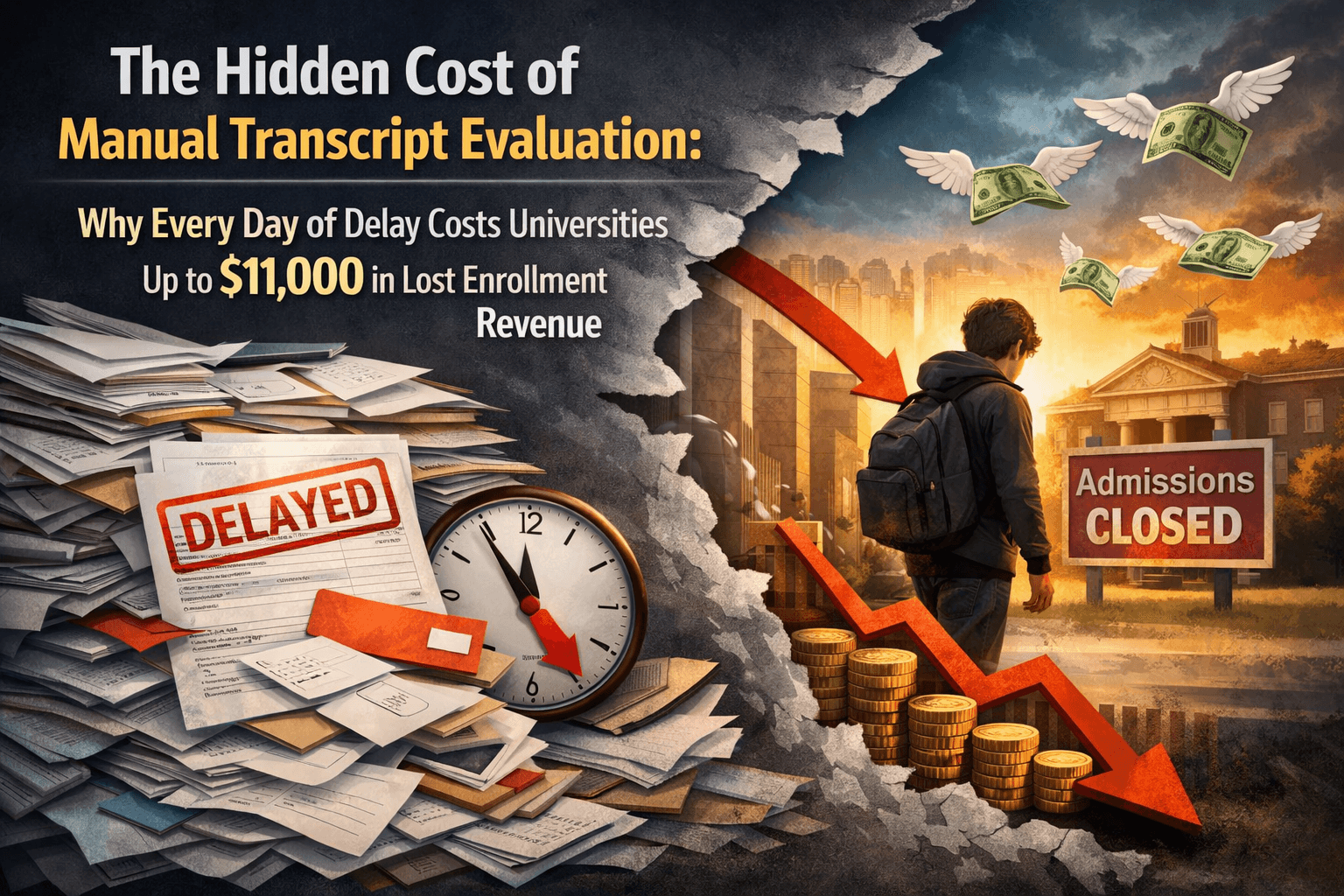
A few weeks ago, I found myself in a conversation with the admissions director at a mid-sized university in the Southeast. She was describing the backlog problem they face every spring. How the team falls further behind as applications spike, how qualified candidates accept offers from competing institutions while their transcripts sit in the evaluation queue, how staff work overtime just to stay afloat. It’s a story I’ve heard dozens of times from admissions professionals across the country.
What struck me about this particular conversation wasn’t the problem itself—transcript processing bottlenecks are nothing new. What struck me was the lack of clarity around the actual cost of the status quo. When I asked what it was costing them to maintain manual workflows, she paused. Labor costs, sure. Overtime, definitely. But the lost enrollment? The competitive disadvantage of being slow when peer institutions are fast? Those numbers weren’t on anyone’s dashboard.
This post is an attempt to surface what’s been hiding in plain sight: the real cost of manual transcript processing. Not in abstract terms, but in enrollment outcomes, revenue, and competitive position—and increasingly, the cost of not adopting more automated, in-house credential evaluation workflows.
The Processing Gap
Let me start with the basics. Manual transcript evaluation workflows—the kind still in use at most institutions—take between five and seven business days on average. Whether you call it transcript processing or internal foreign credential evaluation, the underlying process is largely the same: between document intake and final result delivery the rest of the steps like manual transcript parsing, and course-by-course evaluation are all done by hand.
Five to seven days might not sound terrible in isolation, but context matters.
Institutions that have adopted automated transcript processing—or more broadly, automated credential evaluation for admissions—are making the same decisions in one to two days. Sometimes faster. The technology exists. It’s not experimental. It’s in production at peer institutions right now, and the gap is widening.
The problem is that admission is becoming a velocity game. The institution that makes the decision first has a meaningful advantage. We conducted a survey on international applicants and transfer students' behavior over the past year, and the results make this point painfully clear: 68% of applicants accept the first offer of admission they receive.
Once a student receives an admission decision, the window to influence their choice is roughly 72 hours. After that, they’ve mentally committed. They’ve started picturing themselves on that campus. They’ve told their family. The decision has been made, even if the paperwork hasn’t been signed yet.
If your evaluation process takes a week, you’ve already lost the window. By the time your offer reaches the student, they’re celebrating an acceptance from somewhere else. You never get the chance to make your case.
What Gets Lost
The most direct cost of manual processing is lost enrollment. Institutions tracking this are seeing patterns that should be alarming.
In a typical mid-sized university, on average 20 qualified candidates per month in the admission season—students who meet institutional criteria, who would likely thrive at the university, who represent genuine enrollment opportunities—are accepting offers from competing institutions before slower-processing universities even finish evaluating their credentials. That’s the gap. That’s what the disadvantage actually looks like in practice.
When you convert that into revenue, the numbers become stark. Depending on tuition rates and assumptions about yield, this translates to somewhere between $150,000 and $220,000 in lost tuition revenue every single month of the admission cycle. That’s not enrollment you failed to recruit—that’s enrollment you recruited successfully but couldn’t capture because your credential processing infrastructure was too slow.
And that’s just the direct cost. The indirect costs are harder to quantify but equally real. Staff morale takes a hit when teams are perpetually behind. Data quality degrades when evaluators are rushing through manual course-by-course evaluation. Applicant experience suffers when students wait weeks for decisions. Each of these has downstream consequences.
What Peer Institutions Are Seeing
This isn’t theoretical. Our internal market research over the past year has identified at least four peer institutions in the Southeast region that implemented automated transcript processing—or what many now describe as in-house international transcript evaluation platforms—in 2024 or early 2025. The early results are instructive.
Transfer students are the clearest signal. Institutions with automated workflows are seeing yield rates among transfer students improve by roughly 40%, and they’re attributing it directly to faster credit evaluation turnaround. Think about what that means. A transfer student applies to multiple institutions. The one that can tell them within 48 hours which credits will transfer, how those credits map through credit equivalency, and how they apply to degree requirements has a massive advantage over the one that takes three weeks to do the same analysis.
This isn’t just about speed for speed’s sake. It’s about giving students the information they need to make informed decisions while they’re still making decisions. Once they’ve committed elsewhere, it doesn’t matter how good your credit transfer policy is. They’re gone.
The same dynamic applies to international students, though the evaluation complexity is higher. Institutions with automated workflows can provide clarity on GPA equivalency, grading scale conversion, and institutional recognition within days. Manual workflows take weeks. By the time the evaluation is complete, the student has moved on.
What Automation Actually Changes
When people talk about automated transcript processing, there’s sometimes a misconception that it’s just OCR—optical character recognition that reads documents and spits out data. OCR is part of it, but it’s not the whole story. The platforms that are delivering real value are handling the full evaluation workflow—from academic document intake to course-by-course evaluation reports.
Document intake is the first step. Intelligent document processing can read transcripts in more than 50 languages, handle both printed and handwritten formats, and automatically classify documents by type. ID documents get separated from transcripts. Transcripts get separated from degree certificates. Records get grouped by educational level—bachelor’s, master’s, and so on. Evaluators see what they need without having to sort through a pile.
Grading scales are preloaded for every country, and for larger countries, you get institution-specific grading norms drawn from public sources. Evaluators can customize these scales, build new ones from scratch, or import them directly from their CRM or institutional database. When a GPA conversion happens, it’s instant and auditable—you can trace it back to the exact scale that was applied.
For domestic transfers, the platforms support structured credit mapping (e.g., CIP/SCED alignment), which allows articulation logic to be applied programmatically. Does this transferred course satisfy the degree requirement? Does it meet the prerequisite for the next course in the sequence? The system can check that automatically, based on institutional rules.
Course equivalency and GPA conversion workflows are where this gets really powerful. Instead of an evaluator manually comparing syllabi and course descriptions, the system can flag likely matches based on course codes, titles, descriptions, and credit hours. With pre-populated grading equivalency databases and recommendation layers, the evaluator’s job shifts from manual comparison to informed decision-making. The evaluator still makes the final call, but the groundwork is done. That shift improves turnaround time, consistency, and accuracy.
With the emergence of AI—and the ease with which fraudulent credentials can now be produced—fraud detection has become table stakes. Modern systems can flag inconsistencies in document layout, typography, seal placement, and grade sequences—signals that are easy to miss at volume. It’s not perfect, but it materially raises the bar for detecting fraudulent academic credentials.
Accreditation status verification and institution recognition have always been critical in qualification assessment. Platforms are increasingly able to provide structured, real-time checks against recognition databases, regulatory notices, and historical accreditation records. Not just whether an institution is recognized today, but whether it was recognized when the student attended.
For cases that need deeper validation, platforms support layered primary source verification (PSV) - with direct institutional verification via API or secure file transfer; email or phone verification; government registries or third-party databases.
Integration with CRMs and student information systems is critical. Extracted data needs to flow directly into systems like Slate or Salesforce without duplication. If evaluators have to re-enter data manually after extraction, you haven’t actually solved the problem.
Throughout all of this, transparency and auditability are non-negotiable. Evaluators need to see how data was extracted, review outputs, and trace any equivalency decision back to the source document and applied logic. If you can’t explain a decision, you can’t defend it.
The Real Question
I started this post talking about a conversation with an admissions director who couldn’t quantify what manual processing was costing her institution. By now, I hope the answer is clearer.
It’s costing roughly $265,000 to $335,000 per month in direct and opportunity costs. It’s costing 20 qualified candidates per month who enroll elsewhere while waiting for evaluation. It’s costing competitive position as peer institutions adopt faster, in-house credential evaluation systems. It’s costing staff morale as teams fall further behind every peak season.
The real question isn’t whether to automate. It’s how quickly.
Every day of delay represents roughly 0.8 to 1.1 lost enrollments. Not because the institution is making bad decisions or because the staff is underperforming. Because the infrastructure is too slow. The candidate moved on. You never got the chance to compete.
The tools exist. The ROI is measurable. Peer institutions are already seeing the benefits. The question for admissions leadership is whether they can afford to wait.
What’s Available
For institutions ready to close the processing gap, platforms like TruEnroll are designed to integrate with existing workflows. They enable a true in-house credential evaluation model—covering transcript parsing, course-by-course evaluation, fraud detection, and primary source verification within a single system. Evaluators retain full oversight and decision authority.
AI handles the repetitive, time-consuming steps that create bottlenecks—data extraction, document classification, equivalency flagging—while preserving transparency and control.
The infrastructure we’re building today isn’t meant to eliminate the need for skilled evaluators. It’s meant to give them better tools so they can focus on the work that actually requires expertise—nuanced policy interpretation, complex equivalency cases, applicant advising, yield management.
The work that makes the difference.
If you want to see what this looks like in practice, TruEnroll offers demonstrations at truenroll.com or via app.truenroll.com.